Lootbound Steam Demo Review
Played 17 Jul 2026 · 7h 30min
Verdict: Play
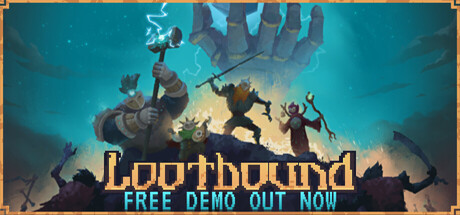
A tactical loot-management roguelike where bag Tetris and boss-part choices keep pulling you back, even when the final b
Lootbound has its hooks into me. I've played for seven and a half hours and I still have not beaten the final boss, so I'm going back in. It's the reason I haven't finished many other reviews this week. It walks the line between frustration and that glimpse of being so close, and I keep queuing another run. The store page sells fair difficulty. After the final boss absolutely trashed me, I would strongly disagree with that.
My verdict is a play. It's just so well put together. Lootbound has eaten seven and a half hours of my week, I still haven't killed the final boss, and it's going to take more, so some of the other games I had planned this week probably aren't getting finished. I don't really mind. I've enjoyed it, I can see why the reviews are so good, and I'm still going back in for that boss. That's a play.
Pros
- Bag Tetris with aura synergies, especially parking a vampirism ring so every weapon it touches leeches life back.
- Risk-reward blacksmith gems and deity trades that make each node feel like a real bet before a fight.
- Building the final boss from phase parts, then nearly beating the monster you helped assemble.
- Hand-drawn look, always-clear fights, and dice rolls that come through the screen like your own hand.
- The pace swap between calm bag building and the turn-based battle keeps a half-hour run from going stale.
Look and feel
The demo already sits on a Very Positive Steam score across hundreds of reviews, and I can see why. Everything is hand-drawn and beautifully animated. It's always clear what's going on, and the tiny details draw you in.
There are moments where you're rolling a dice and it comes in through the screen, like it's your own hand doing the rolling. It's been done with a lot of care.
Map, inventory, and the bag puzzle
In the demo you only play as the warrior. You start with two special abilities and an empty bag, then pick your way along a road-like map. Nodes are shops, battles, harder battles, rest points, deities where you surrender some mana for a strong item, and a blacksmith who can add a gem to your gear to boost its stats.
The blacksmith runs on a difficulty class, similar to D&D. Roll above it or the gem doesn't stick. Fail and you get an extra roll with a special dice, with faces like 1, 3, 5, and 8 to 10, that adds to your first roll. Chests work the same way, giving you three options each sitting behind its own difficulty class. The better the upgrade, the higher the DC. That risk-reward layer is pure RPG decision-making before you've even opened a fight.
A lot of the Strategy sits in the inventory. The space is fixed and every item is a different shape, so you're playing Tetris in your bag, trying to fit as much as possible. My favourite find was a ring that adds vampirism, life steal, and health for every weapon it touches. I had to park it in the middle and wrap my weapons around it. The weapons are all different shapes and some are huge, so fitting as much as possible around the ring without eating too much space gets tricky. On top of that you're choosing between loads of health and armour for defence or all of your attack abilities.
Companions, stats, and building the boss
You pick up party members as you go, choosing from a paladin, a witch, and a bard. They each do something slightly different and each gets their own bag, so you're fitting their equipment in to best meet their stats too. In combat you only control the warrior. Companions pick their own attacks, and the game tells you who they'll target, usually the enemy on the lowest health.
There is a large amount of statistics to look at. I spent the first few runs almost ignoring most of them, just going on vibes. It was only later that I started paying attention to what each stat meant and how it might benefit me against certain enemies.
At the end of each phase you pick a part of the final boss, and after three phases you face whatever you assembled. One choice gives it extra armour and dodge. Another adds rage and vampirism every time it attacks. One adds thorns. On one of my best runs I picked thorns, and I can't think why, because thorns reflect damage back on the attacker and I ended up killing myself. The elite battles got me the same way. There's a tree with 500 armour and eight thousand health, and because I'd gone all offensive I couldn't do enough damage to overcome its life steal, and every hit back dealt thorn damage to me. Fair difficulty.
Runs, meta progression, and the pace swap
You also add abilities during the map run. Some boost your attack, some boost your allies, and some deal extra damage but spend mana, so mana becomes another resource to manage. I've made it to the boss about four times and lost every single time. Once it crit me and one-shot me because I hadn't been stacking health and armour. Once I got really close, one hit away, with a lot of attack and a lot of vampirism. If that attack had landed I'd have fully healed and left the boss on about a thousand health. They dodged. I had a hundred health left and the next swing took me out. That level of almost-there-but-not-quite is exactly what keeps hooking me in.
A run is about half an hour. The map changes each time, as does who you can recruit, which abilities are on offer, and what's in the chests. There's a meta progression layer too. Memory crystals go into your basic starting stats, and if you die you only keep half the crystals you collected, then spend them on things like extra slash damage, force, and dodge.
This is the second recent demo I've played where inventory Management opens into a more active Roguelike fight, after Void Reaver, and I like that change of pace. The bag building is an enjoyable little game on its own. Then you finish the admin and drop into the more turn-based battle, deciding which abilities to use and which enemy to take out first. That swap between the two keeps the Adventure engaging without becoming repetitive.
Game Info
- Developer
- ArtDock / Dreland Enterprises
- Publisher
- ArtDock / Dreland Enterprises
- Released
- 14 August 2026
- Full game
- Out now ($14.99)
- Platform
- PC, Mac, Linux
- Multiplayer
- No
- Controller
- No
- Playtime
- 7h 30min
Tags: Strategy, Roguelike, RPG, Management, Adventure, Indie
Related Reviews
- Teeko: Teeko is a cute sloth Tower Defense platformer where defending Granny's food stand with coconut trees worked better than
- Crimson Horn: A roguelike autobattler where rare weapons are not always better, lantern summoning lives on the gear not the necromance
- Knightstones: A tactical roguelike where you command from a golden castle balcony, fight on stripped-back cream battle maps, and lose
- Dark Rail: A turn-based management roguelike where you run an Inquisition city by train, hunting heretics and shipping prisoners. I
- Slotbound: A roguelike auto-battler where you spin a 3x3 slot machine to summon your army instead of choosing it. I meant to give i
- Void Reaver: Bullet heaven where your backpack is the build, and Tetris in the shop is half the fun.